
The great American road trip has been a passion for adventure’s since at least 1880. Surprisingly, the cornerstone for this phenomena is the lowly bicycle.
In the late 19th century, bicycle mania swept across the country. And that played a pivotal role in the development of the Good Roads Movement that led to the creation of the US highway system. It also figures prominently in the story of how the American auto industry was established. The bicycle, a symbol of freedom and mobility in the late 19th century, became a catalyst for change in transportation infrastructure and dramatic societal evolution in the early 20th century.
The Bicycle and the Good Roads Movement
The origins of the Good Roads Movement can be traced to the initiatives launched by the League of American Wheelman, a powerful grassroots organization launched to improve the deplorable state of America’s rural roads for bicyclists. Founded in 1880, the League of American Wheelmen became a powerful advocate for better roads. The organization published the influential Good Roads Magazine and lobbying for road improvements at the state and federal level.
Bicyclists argued that improved roads would benefit not only cyclists but also farmers and rural communities by facilitating easier transportation of goods and better connectivity to urban centers. This advocacy established a network of like minded partnerships that laid the groundwork for the modern highway system. And the visionary’s and entrepreneurs that launched the burgeoning automobile industry quickly built on that legacy as they recognized that an improved highway system would translate to automobile sales.
The Bicycle Industry and Early Automobiles
The bicycle industry significantly influenced early automobile manufacturing. Many of the pioneering automobile manufacturers, including Karl Benz, Louis Chevrolet, Alexander Winton, and Thomas Jeffrey, launched their careers with bicycle repair or manufacturing.
Benz’s first automobile, the Benz Patent-Motorwagen, incorporated bicycle components such as spoked wheels and rubber tires. Before launching a bicycle manufacturing company, Louis Chevrolet worked in a shop repairing bicycles. He also raced bicycles before turning his attention to automobiles with his brothers Arthur and Gaston.
In retrospect the transition from bicycles to automobiles was a natural progression, as both industries shared a focus on personal mobility and mechanical innovation. The skills and technologies developed in the bicycle industry provided a foundation for the nascent automobile industry, leading to the creation of more advanced and reliable vehicles.
Pioneering Automobile Manufacturers and the Great American Road Trip
The 20th century dawned with daring automobilists pushing the boundaries of travel by automobile, and automotive technology. They were also building on the League of American Wheelman as their exploits fueled an ever growing Good Roads movement.
Pioneering automobile manufacturer Alexander Winton made a valiant attempt to complete the first coast to coast drive by automobile shortly after the turn of the century. But the complete lack of roads in the inhospitable landscapes of Nevada proved insurmountable.
The first transcontinental trip by automobile was accomplished by H. Nelson Jackson and Sewall Crocker in 1903. As a curious historic footnote they proved the viability of long distance travel by automobile by driving a Winton touring car from California to New York.
Other notable pioneers included Jacob Murdock, who completed a cross-country trip with his family in 1908, and the Glidden Tours, organized by the American Automobile Association, which promoted the reliability and adventure of automobile travel
These early road trips helped ignite a passion for the Great American road trip and showcased the automobile as a symbol of freedom and exploration.
Societal Impact of Automobile Ownership and Travel (1900-1930)
The societal impact of automobile ownership and travel between 1900 and 1930 was profound and transformative. The automobile revolutionized American life in several ways:
- Economic Growth: The automobile industry spurred economic growth by creating jobs in manufacturing, road construction, and related industries such as oil, rubber, and steel. In turn the increasing use of automobiles in long distance travel gave rise to the establishment of motels, gas stations, garages, towing companies, and roadside diners.
- Urban and Rural Connectivity: Automobiles bridged the gap between urban and rural areas. They provided people of all socioeconomic groups to travel more freely and access new opportunities. And the automobile provided rural families easier access to markets, to schools, and to opportunities that allowed for interaction with diverse cultures in cities.
- Social Changes: The automobile altered social dynamics by providing greater independence and mobility. It changed dating practices, family vacations, and leisure activities. Teenagers gained newfound freedom, and families could explore previously inaccessible destinations.
- Cultural Shifts: The car became a cultural icon, symbolizing progress, modernity, and the American dream. It influenced art, literature, and popular culture, shaping the collective imagination of the nation.
The bicycle and the Good Roads Movement played crucial roles in the development of America’s transportation infrastructure and the rise of the automobile industry. Pioneering automobile manufacturers and early road trips ignited a passion for travel and exploration, while the societal impact of automobile ownership between 1900 and 1930 was nothing short of transformative.
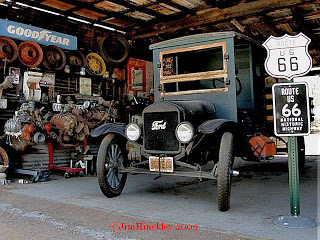
The legacy of these developments continues to shape America’s love affair with the open road. The Route 66 renaissance movement is just one example.
The enduring popularity great American road trip, and the affection for the Model T and Model A Ford that is being inspired in a new generation was the subject of our March 9, 2025 conversation with Ryan Thibeault, the owner of Tebo Barn LLC in Milton, New Hampshire on Coffee With JIm.
On that episode of the podcast from Jim Hinckley’s America, Ryan shared the story of taking his driving test in his grandfather’s 1929 Ford Model A Phaeton. Jim HInckley and Ryan also discussed his passion for driving, restoring, repairing these classic automobiles, and for inspiring a new generation of vintage car owners. A highlight of the conversation was a discussion about about road trips including Ryan’s epic adventures, driving a 1929 Ford across America, including Route 66 from end to end, covering 8,011 miles in 4 weeks!


Thank you. Shared adventures are the best adventures.