
Boom, Bust, and Branding: How the Great Depression and Bold Marketing Put Route 66 on the Map
Few roads embody the American spirit of resilience that is made manifest in reinvention quite like Route 66. Born in the optimism of boom times in the Roaring Twenties, forged in the crucible of the Great Depression, and for nearly a century immortalized in popular culture, Route 66 has weathered economic storms, social change, and shifting travel trends.
But have you ever wondered how a mere highway became an enduring icon? How did a decommissioned highway come to symbolize the quintessential American road trip for a legion of international fans?
The answer lies in a savvy mix of necessity, bold marketing, and the determined spirit of members of the US Highway 66 Association that built a sense of community and a network of cooperative partnerships.
The Road to Ruin: Causes of the Great Depression
To understand why marketing Route 66 was so crucial during the 1930s, we have to step back and examine the economic catastrophe that made travel and tourism a hard sell. The Great Depression wasn’t an instant economic collapse. It was the culminations of a perfect storm of financial missteps, dramatic environmental changes, bad governmental policy, and global consequences.
- The Credit Bubble and Stock Speculation: The 1920s were a decade of easy credit and speculative investments. Many Americans played the stock market with borrowed money. Wealthy investors manipulated markets by gaining control and then consolidating banks that made sweetheart deals for companies that they owned. But when the bubble burst with massive stock devaluations and sell off in October 1929, fortunes vanished overnight. To learn more about the role of banking as a catalyst for the Great Depression I suggest reading Breaking the Banks in Motor City: The Auto Industry, the 1933 Detroit Banking Crisis and the Start of the New Deal By Darwyn Lumley.
- Declining Agricultural Prices: Farmers had thrived during World War I, but when demand plummeted after the war, international prices collapsed, leaving many in crushing debt.
- Rural Bank Closures: Small-town banks, often reliant on agricultural loans, began to fail in the 1920s, setting the stage for the financial crisis that would spread nationwide.
- The Smoot-Hawley Tariff Act: This 1930 legislation, a law designed to protect American industry by implementing protectionist trade policies in the United States, had the opposite effect. By sparking an international trade war, it crippled exports, worsening an already dire economic situation.
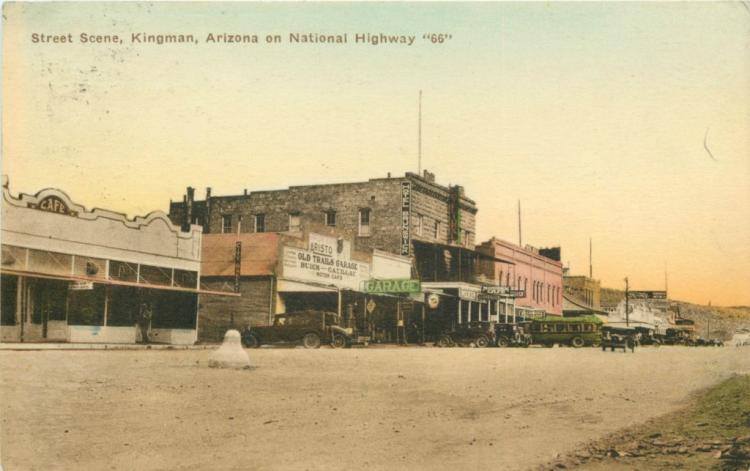
With businesses shuttering, farms failing, and breadlines growing, Americans were desperate for opportunity—and for many, that opportunity lay westward. That unprecedented migration proved to be a lifeline for hardworking entrepreneurs that established towing services, garages, service stations, cafes, and motels or campgrounds.
Selling the Mother Road: The US Highway 66 Association and Depression-Era Marketing
While much of the nation reeled, a group of enterprising businessmen saw a golden opportunity in Route 66. It was an era of boom, bust, and branding.
Founded in 1927, the US Highway 66 Association quickly set to work branding the road as the best route for cross-country travel. But it was during the Great Depression that their marketing efforts truly took off. And that shaped the legacy of the highway for generations to come.
The 1933 Convention in Elk City: A Turning Point for Route 66
In 1933, the US Highway 66 Association hosted a crucial convention in Elk City, Oklahoma. Attended by local leaders, as well as thousands of business owners, politicians, and civic boosters from all along the Route 66 corridor, this event was pivotal in transforming the highway into a national symbol.
At the convention, the focus was on promoting the highway as the best route to the west—both for ordinary Americans fleeing the Dust Bowl and for tourists looking for adventure. In essence it transformed the association into a chamber of commerce for the linear community that was Route 66 from Chicago to Los Angeles.
The association’s strategic decision to emphasize Route 66 as the path to a better life resonated with Americans struggling to survive. They didn’t just market a road—they marketed a symbol of hope.
WPA-Funded Tourism Marketing Materials: Turning the Tide
As the Depression dragged on, the Works Progress Administration (WPA), a New Deal agency, began funding initiatives aimed at revitalizing the American economy. One aspect of this was the development of tourism marketing materials through programs that supported authors, photographers, and artists. Many of thse resources were channeled into producing travel pamphlets, feature article, and murals that showcased the allure of America’s landscapes.
Photographers like Dorothea Lange and Walker Evans captured iconic images of struggling Americans, but also images of hope and the beauty of the open road. Their work, along with the WPA’s funding of guidebooks and literature, made Route 66 a central feature in the nation’s vision of travel during the Great Depression. These marketing materials not only gave travelers a visual map to follow but also painted a vivid picture of the American dream, forever tying Route 66 to the spirit of adventure.
The Auto Industry’s Dramatic Transition: 1920-1940
While Route 66 was emerging as the nation’s premier road for adventure, the American auto industry was undergoing a transformation of its own—a shift that would forever change travel in America.
In 1920, the U.S. had more than 100 automobile manufacturers. From small startups to well-established names, the auto industry was a highly competitive and fragmented market. The post WWI economic recession weakened many small independent manufacturers.
Companies like Packard, Nash, Studebaker, and Hudson vied for dominance competing with giant manufacturing combines such as General Motors. Surviving small manufacturers such as Checker tried to carve out their own niches.
By contrast, the Ford Motor Company had a commanding presence with the Model T, making cars more affordable and accessible for the masses. An industry survey in 1920 found that worldwide three of five automotbile on the road were manufactured by Ford.
However, the Great Depression brought swift and brutal consolidation to the industry. By 1930, the economic fallout from the stock market crash, combined with a shrinking market and mounting consumer debt, led to massive corporate shakeups. Some companies, like Pierce-Arrow and Franklin, were forced into bankruptcy or merger. Others, like Chrysler and General Motors (GM), emerged as the dominant players by aggressively acquiring smaller companies and expanding dealer networks.
Between 1929 and 1933, the number of manufacturers dwindled dramatically. But, surprisingly, it was also an era of innovation.
Chrysler, with its introduction of the Chrysler Airflow in 1934, also reshaped the market, focusing on innovative designs and luxury features that appealed to a new class of travelers looking for comfort on the open road. The Duesenberg manufactured by the Auburn/Cord/Duesenberg Company in Auburn, Indiana was the most powerful and most expensive car manufactured at the time.
The industry’s transformation during the 1930s wasn’t just about the closure of brands. It was about how automakers redefined the American car.
The Ford Model A, released in 1927, signaled the beginning of a new era of style and performance. This shift would accelerate throughout the decade as vehicles became more powerful, more stylish, and more reliable, aligning perfectly with the ideals of long-distance travel.
This dramatic restructuring of the automobile industry had profound implications for Route 66. As cars grew more reliable and comfortable, road travel became more feasible, especially on improved highways like Route 66 that connected major cities across the country. This coincided perfectly with the promotional efforts of the US Highway 66 Association, which was positioning Route 66 as the ultimate road trip destination and ideal trade corridor.
A Legacy That Rolls On
The Great Depression may have been a time of hardship, but for Route 66, it was a proving ground. The promotional efforts of the US Highway 66 Association didn’t just help struggling towns survive. This was the foundation that created a mystique that has endured into the 21st century.
Today, travelers still flock to Route 66, drawn by its history, its nostalgia, and the spirit of resilience it represents. From the time capsule motels of Tucumcari like the Roadrunner Lodge to the vintage diners of Missouri, the road remains a living testament to the power of branding, the promise of the open road, and the idea that sometimes, the best way forward is a highway stretching west.
And that, my friends, is a condensed of the story about how Route 66 went from a Depression-era lifeline to a legend. Sharing America’s story, and inspiring road trips by telling people where to go. It’s what we do at Jim Hinckley’s America.


Thank you. Shared adventures are the best adventures.