
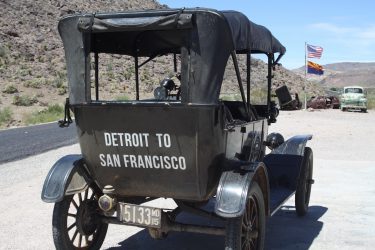
Before the Mother Road there were trails, there were ancient villages, and there were stories. Move beyond tail fins and neon, and add some pre 1926 historic sites to your next road trip adventure on Route 66, and it will forever change how you see the legendary double six.
Long before Route 66 became America’s Main Street, a patchwork of trails, railroads, and wagon roads carved a path westward from Chicago to Los Angeles. They were the foundation for the storied highway that we revere today. And they are a big part of the highways centennial story.
These forgotten corridors are more than a prelude to the double six. They are the first chapters in a grand adventure. At Jim Hinckley’s America, we celebrate this rich legacy by telling folks where to go—and why.
We share the adventure, America’s story, and we inspire road trips steeped in history. Today, let’s hit the road and explore some of the fascinating pre-1926 sites that predate Route 66 but still dot its winding path from Chicago to Santa Monica.
Ash Fork, Arizona – Oasis of the Frontier
The junction of three tributaries of Ash Creek was a lifeline for Native Americans, Spanish explorers, and Army survey teams in the 1850s. Ash Fork blossomed in 1882 with the arrival of the Atlantic & Pacific Railroad and quickly became a key water stop.
Looking for a unique landmark? In 1898, just west of town, near the wagon road that would become Route 66, the railroad built a prefabricated steel dam. This engineering marvel that is now listed on the National Register of Historic Places is a rarity as few of these dams remain.
Canyon Diablo – The Chasm that Nearly Bankrupted a Railroad
Twenty-five miles west of Winslow, this yawning canyon presented a nightmare for 19th-century surveyors. Lieutenant Whipple named it in 1853, and the Atlantic & Pacific Railroad nearly collapsed financially while building a bridge over it, and then a tunnel in Johnson Canyon, in 1882.
That bridge didn’t just span a gap. It was the first milestone in Arizona’s march toward the modern era. And it set the course for Route 66.
Crozier Canyon Ranch – A Frontier Resort Along the Beale Wagon Road
One of northern Arizona’s oldest ranches, Crozier Canyon Ranch began as a campsite oasis along the Beale Wagon Road in the 1860s. By the 1920s in the era of the National Old Trails Road, predecessor to Route 66 in the southwest, it was a working ranch as well as a full-fledged resort.
There were cabins, a spring-fed swimming pool, and even Sunday train excursions from Kingman. When torrential floods hit in 1937, the resort faded, and Route 66 was realigned. Many original structures, including the mid 19th century ranch house still stand but the entire complex is on provate property.

Hackberry – From Mining Camp to Highway Stop
For Route 66 enthusiasts the old Hackberry General Store is a revered landmark. But it only dates to the highway realignment of the 1930s.
South of the highway is remnants of the old town that was once given consideration to become the Mohavev County seat. Named for a desert tree found at the springs, and then a silver mine in the 1870s, the town of Hackberry boomed with ranching, mining, and the Atlantic & Pacific Railroad.
Though the mine went bust, the town survived thanks to the National Old Trails Highway and, later, Route 66. Hackberry’s two-room schoolhouse, which closed in 1990, was Arizona’s last of its kind.
Oatman and Sitgreaves Pass – Trails of Gold and Legend
The rugged Black Mountains of western Arizona held riches and risk. Sitgreaves Pass—named after an 1851 Army expedition—became a critical route for miners, soldiers, and later, travelers on the National Old Trails Road. In the summer of 1915, Edsel Ford driving a Model T was one of the travelers that inched their way along cliffside curves with precipitous drops.
Oatman, with its 1902 adobe Durlin Hotel and burro-filled streets, remains a blurring of romanticized images of the wild west and Route 66. Other links to the highways history are found at the site of Ed’s Camp, the ruins of Goldroad, Cool Springs, and the site of Snell’s Summit Station at the top of the pass.
Valentine – A Legacy of Education and Assimilation
Near the now-quiet outpost of Valentine, Arizona, stands a haunting two-story red brick schoolhouse. This is one of the last remnants of the Truxton Canon Indian Boarding School.
Built in 1903, it was once part of a complex that through forced education initiatives aimed to assimilate Hualapai and other Native American youth by seperating them from family and culture. Though the school closed in 1937, its memory and remaining buildings remain, silently telling a more complex American story.
As an FYI, when some of the buildings were razed the bricks were salvaged. They were used in the construction of the Mohave Museum of History & Arts in Kingman, Arizona.
Explore Further With the Route 66 Historic Atlas
These stories and dozens more are lovingly chronicled in my book The Illustrated Route 66 Historical Atlas. I highly recommend this book if you are a traveler who wants to do more than follow signs. It’s part guidebook, and part time machine. Between the cover you will find trivia, and lots of road trip inspiration.
Pick up your copy at:
- Amazon
- Barnes & Noble
- Your favorite local bookstore or gift shop along Route 66 including the iconic Wagon Wheel Motel in Cuba, Missouri.
Ride Along with Jim Hinckley’s America
If you enjoy this type of storytelling, don’t just read it—live it! Be part of our road trip community:
- Follow the “Coffee With Jim” Podcast on Podbean – where every episode is a front-porch chat about America’s highways, history, and hidden gems.
- Like Jim Hinckley’s America on Facebook – stay connected with daily updates, vintage photos, trivia, and travel inspiration.
- Subscribe to this blog – so you’ll never miss an article, announcement, or another shared adventure.
Let’s hit the road, together. The story of Route 66 doesn’t start in 1926—and at Jim Hinckley’s America, neither does yours.


Thank you. Shared adventures are the best adventures.